How did all the different kinds of plants and animals in our world evolve?
My research focuses on investigating the processes of speciation and adaptation. My hope is that by learning more about how species are formed and how they adapt to their environment, we may also learn more about how to protect them from extinction in a rapidly changing world.
We typically think of the speciation process -how new species are formed- as the evolution of barriers between diverging populations that prevent them from reproducing with one another and exchanging genes (gene flow). My main research interests include investigating what these reproductive isolation barriers are, how and to what extent they are shaped by the environment, and what their genetic basis is. I combine a multitude of methods and tools to probe these questions, from behavioral experiments and morphological measurements to genomic analyses.
Organismic and Mechanistic Barriers to Gene Flow
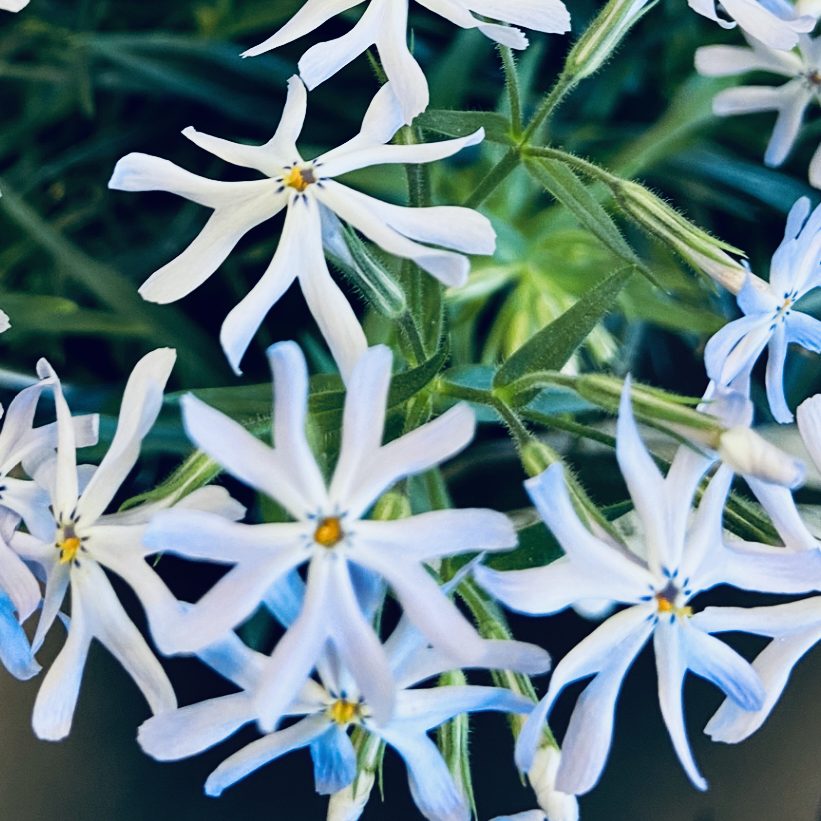
Recently, I performed a large crossing experiment involving eight species of Phlox wildflowers with different divergence times and broadly overlapping ranges in the states of Illinois and Indiana (USA) to assess the strength of post-mating prezygotic (pollen-pistil interactions) and postzygotic barriers (F1 hybrid viability and fertility). Some of these results are now published in Feller et al. 2024. I also assessed the strength of pre-mating reproductive isolation due to differences in phenology using publicly available occurrence data with photos and computer vision, and ongoing work explores if there is ecogeographic isolation between the eight species using species distribution models.
One of my main questions in this project is to what extent the strength of these measured isolating barriers correlates with genomic inferences of gene flow – which is assumed but has rarely been formally tested.

Eight species of Phlox wildflowers with widely overlapping geographic ranges in Illinois and Indiana, USA.
In my very first research project (bachelor’s thesis), I performed behavioral experiments to assess habitat choice and female preference in a population of stickleback fishes with two male color morphs that breed in distinct habitats in a small pond near Bern, Switzerland. The results from this study (Feller et al. 2016) and another study on this system (Marques et al. 2017) suggest that environment-dependent sexual selection likely drove phenotypic (and genomic) divergence between the two sympatric morphs.


Genetic Basis and Genomic Architecture of Barrier Traits
When the traits that play a role in affecting reproductive isolation are known, their genetic architecture and genetic basis can be assessed. This involves a variety of genetic and genomic methods and tools.
There are theoretical predictions about how different types of architectures may facilitate or restrain the evolution of reproductive isolation. One such prediction for instance is that when there is some gene flow in a situation without any geographic or physical barriers between populations (sympatry), a divergent trait that is coded by a gene / genomic region with a large effect is more likely to persist than one coded by many genes with small effects. I used a QTL mapping approach to investigate this hypothesis in two species pairs of Lake Victoria cichlids with a similar color difference, one of which occurs in complete sympatry (no geographic or physical isolation) and the other is never found in sympatry (Feller et al. 2020).


In a cross between sympatric sister species (the top two species on the left) where one species has a red dorsum and yellow flanks and the other species is blue, we found QTLs of large effect for the red/yellow traits (shown in the QTL plot on the right). In a cross between two sister species (the bottom two species on the left) with a similar color difference but that are never found in sympatry, we did not find any QTLs with large effect (not shown). These differences in the genetic architecture of superficially similar trait differences may explain why species with the red dorsum color motif are often sympatric with blue sister species, whereas those with the red-chest pattern cannot seem to retain differentiation from their blue relatives in sympatry (Feller et al. 2020).
I also studied the genetic architecture of traits not directly involved in reproductive isolation but important for rapid ecological diversification (which then led to many speciation events) in the Lake Victoria cichlid adaptive radiation (Feller et al. 2022), as well as the potential role of postzygotic incompatibilities (Feller et al. 2024).


The genomic regions that underlie a suite of co-adapted traits differentiating an insectivorous from a herbivorous Lake Victoria cichlid species are distributed over many chromosomes. We found some linkage/pleiotropy within trait complexes, but the QTLs for distinct traits were distributed across several unlinked genomic regions. The emergence and maintenance of associations between these different genomic regions that underlie co-adapted traits that evolved and persist against some gene flow likely required some degree of reproductive isolation (Feller et al. 2022).
My current and future work on Phlox wildflowers includes assessing the basis of gametic and genetic incompatibilities as well as asking more general questions about the genomic architecture of reproductive isolation in this system using a combination of reduced representation whole genome and long read whole genome sequencing.

Phlox wildflowers in their natural habitats (Phlox paniculata on the left, P. divaricata on the right)
 Anna Fiona Feller